
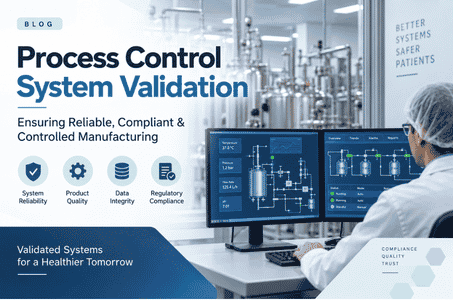
In regulated industries such as pharmaceuticals, biotechnology, medical devices, and healthcare manufacturing, process control systems play a critical role in maintaining consistent product quality and process performance. These systems monitor, control, and sometimes automatically adjust critical manufacturing parameters such as temperature, pressure, flow, pH, speed, humidity, and other process variables.
Because process control systems can directly influence product quality and patient safety, they must be appropriately validated before being relied upon in a regulated production environment.
Process Control System Validation (PCSV) provides documented evidence that a computerized or automated process control system consistently performs its intended functions, maintains data integrity, and operates in accordance with approved requirements and applicable regulatory expectations.
What Is Process Control System Validation?
Process Control System Validation is the documented process of demonstrating that a process control system is fit for its intended use and consistently produces reliable and accurate results within predefined specifications.
A process control system may include:
- Programmable Logic Controllers (PLCs)
- Distributed Control Systems (DCS)
- Supervisory Control and Data Acquisition (SCADA) systems
- Human-Machine Interfaces (HMIs)
- Building and Environmental Monitoring Systems
- Manufacturing Execution System (MES) interfaces
- Sensors and transmitters
- Control loops
- Data historians
- Automated alarms and notifications
- Electronic records and audit trails
Validation considers not only the software application but also the associated hardware, infrastructure, interfaces, configuration, data flows, security controls, and operational processes.
Why Is Process Control System Validation Important?
Manufacturing processes increasingly depend on automated control systems. A failure or incorrect configuration can potentially affect critical process parameters and ultimately product quality.
Effective validation helps organizations:
1. Ensure System Reliability
Validation confirms that the system operates consistently according to approved functional and technical requirements.
2. Protect Product Quality
Properly validated control systems help maintain critical process parameters within established limits, supporting consistent manufacturing outcomes.
3. Maintain Data Integrity
Process control systems generate and manage significant amounts of electronic data. Validation helps ensure that data remains accurate, complete, attributable, consistent, and protected throughout its lifecycle.
4. Support Regulatory Compliance
Validated systems provide documented evidence demonstrating that computerized and automated systems used in regulated processes are appropriately controlled.
5. Reduce Operational Risk
Identifying system weaknesses, incorrect configurations, interface issues, and potential failure modes during validation can help prevent costly production deviations and compliance issues.
Process Control System Validation Lifecycle
A risk-based validation lifecycle provides a structured approach to planning, implementing, testing, releasing, and maintaining a process control system.
1. Validation Planning
The validation process begins with defining the overall validation strategy.
A Validation Plan typically establishes:
- System scope
- Intended use
- Regulatory requirements
- Roles and responsibilities
- Validation methodology
- Risk assessment approach
- Required documentation
- Testing strategy
- Acceptance criteria
- Change control expectations
The plan should clearly establish what components of the process control system are within the validation scope.
2. User Requirements Specification (URS)
The User Requirements Specification defines what the system is expected to do from the user’s and business perspective.
Typical requirements may include:
- Process parameter monitoring
- Automated control functions
- Alarm management
- User access controls
- Data recording
- Electronic records
- Audit trails
- Reporting
- System interfaces
- Backup and recovery
- Security requirements
- Regulatory and data integrity requirements
URS requirements should be clear, measurable, traceable, and testable.
3. Risk Assessment
Risk assessment is an important component of a modern, risk-based validation approach.
The assessment identifies functions and components that could have an impact on:
- Product quality
- Patient safety
- Data integrity
- Regulatory compliance
- Critical manufacturing processes
Higher-risk functions should receive greater validation attention and more comprehensive testing.
4. Functional & Design Specifications
Following the URS, detailed specifications define how the system will meet the identified requirements.
Depending on system complexity, documentation may include:
- Functional Specification (FS)
- Design Specification (DS)
- Hardware Design Specification
- Software Design Specification
- Configuration Specification
- Network Architecture
- Interface Specifications
These documents establish the technical foundation for subsequent qualification and testing activities.
Qualification & Testing
A structured testing strategy provides evidence that the process control system has been properly installed, configured, and tested.
Installation Qualification (IQ)
IQ verifies that the system and its supporting infrastructure have been installed according to approved specifications.
Typical IQ activities include verification of:
- Hardware installation
- Software installation
- Servers and workstations
- PLCs and controllers
- Network components
- Sensors and instruments
- System documentation
- Software versions
- Configuration records
Operational Qualification (OQ)
OQ verifies that the system operates correctly across defined operating ranges.
Testing may include:
- Control functions
- Alarms
- Interlocks
- User access
- Security controls
- Audit trails
- Data recording
- System interfaces
- Error handling
- Backup and restore
- Failure and recovery scenarios
OQ should challenge critical system functions under appropriate conditions to demonstrate that they operate as intended.
Performance Qualification (PQ)
PQ provides documented evidence that the system performs effectively under actual or representative production conditions.
PQ may evaluate:
- Process control performance
- Critical process parameters
- Production workflows
- Operator activities
- Data capture
- Alarm response
- System performance
- Integration with related systems
The exact PQ approach depends on the system’s intended use and risk profile.
Data Integrity in Process Control Systems
Data integrity is a critical consideration when validating process control systems.
Systems may capture large volumes of process data, including:
- Temperature readings
- Pressure measurements
- pH values
- Flow rates
- Batch information
- Alarm events
- Operator actions
- System changes
- Electronic signatures
- Audit trail information
Validation should therefore assess whether data is generated, processed, stored, retrieved, and retained appropriately.
Key controls may include:
- Role-based access
- Unique user accounts
- Audit trails
- Secure timestamps
- Electronic signatures where applicable
- Controlled configuration
- Backup and restoration
- Data retention
- Restricted administrative privileges
- Periodic review of critical data and system activity
Validation of PLC, SCADA & DCS Systems
Different process control architectures require different validation considerations.
PLC Validation
Programmable Logic Controllers are commonly used for automated process control. Validation may focus on control logic, interlocks, alarms, inputs/outputs, sequencing, and fail-safe behavior.
SCADA Validation
SCADA systems provide supervisory monitoring and control. Validation typically addresses visualization, data acquisition, alarms, historical data, user access, audit trails, and communication with field devices.
DCS Validation
Distributed Control Systems are frequently used in complex manufacturing environments. Validation may cover distributed controllers, control strategies, operator interfaces, alarms, historian functionality, batch control, and system interfaces.
The validation strategy should be based on the intended use and risk of the complete system, rather than treating individual components in isolation.
Common Challenges in Process Control System Validation
Organizations may encounter several challenges when validating process control systems.
Legacy Systems
Older PLC, SCADA, or DCS environments may lack comprehensive documentation, making validation and risk assessment more difficult.
Complex System Interfaces
Process control systems frequently exchange data with MES, ERP, historians, laboratory systems, and other computerized systems. Interfaces must be appropriately assessed and tested.
Frequent Changes
Changes to control logic, software versions, hardware, configurations, or process parameters can affect the validated state.
Data Integrity Risks
Inadequate user access controls, audit trails, backups, or data retention mechanisms can create compliance concerns.
Vendor Dependencies
Organizations may rely heavily on system integrators and equipment vendors. Clear responsibilities and appropriate supplier controls are therefore important.
Maintaining the Validated State
Validation does not end when qualification testing is completed.
A process control system should remain under appropriate lifecycle management throughout its operational life.
Important controls include:
- Change Control
- Periodic Review
- Incident and Deviation Management
- CAPA
- Backup & Restore Testing
- Access Review
- Security Management
- Configuration Management
- Patch Management
- Disaster Recovery
- Business Continuity
- Revalidation, where required
Any significant change should be evaluated for its potential impact on the validated state.
Risk-Based Approach to Process Control System Validation
Modern validation programs increasingly emphasize risk-based thinking rather than excessive documentation and testing of every system function.
A risk-based approach helps organizations focus validation resources on functions that have the greatest potential impact on:
Patient Safety → Product Quality → Data Integrity → Regulatory Compliance
For example, a critical temperature control loop directly affecting a manufacturing process may require significantly more rigorous testing than a non-critical informational display.
The validation strategy should therefore be proportionate to the system’s complexity, intended use, and associated risks.
How MedTech CSV Supports Process Control System Validation
A specialized CSV partner can help organizations establish a structured and compliant validation lifecycle for process control systems.
Our approach can support activities including:
- Validation Planning
- System Inventory & Categorization
- GxP Impact Assessment
- Risk Assessment
- User Requirements Specification
- Functional & Design Specifications
- Traceability Matrix
- IQ/OQ/PQ Protocol Development
- Test Execution Support
- Data Integrity Assessment
- Audit Trail Assessment
- Access Control Review
- Validation Summary Reporting
- Change Control
- Periodic Review
- Revalidation Support
By combining risk-based validation principles, computerized system expertise, and regulatory understanding, organizations can improve system reliability while maintaining the required level of compliance.
Conclusion
Process Control System Validation is an essential component of computerized system and manufacturing process control in regulated industries. A properly validated system provides confidence that critical processes are controlled consistently, electronic data remains trustworthy, and the system continues to perform according to its intended use.
From PLCs and SCADA systems to complex DCS environments, validation should cover the complete system lifecycle—from planning and requirements through qualification, release, operation, change management, and retirement.
A risk-based and lifecycle-oriented validation strategy allows organizations to focus resources where they matter most while maintaining control over product quality, data integrity, and regulatory compliance.
Looking to validate your process control system?
Partner with MedTech CSV for structured, risk-based, and compliance-focused validation support tailored to your GxP environment.